The Problem Platform Architecture Use Cases Contact
Enterprise Document Intelligence Platform
Starship Holdings — Fileport.ai

Transform Enterprise
Documents Into
Structured Intelligence

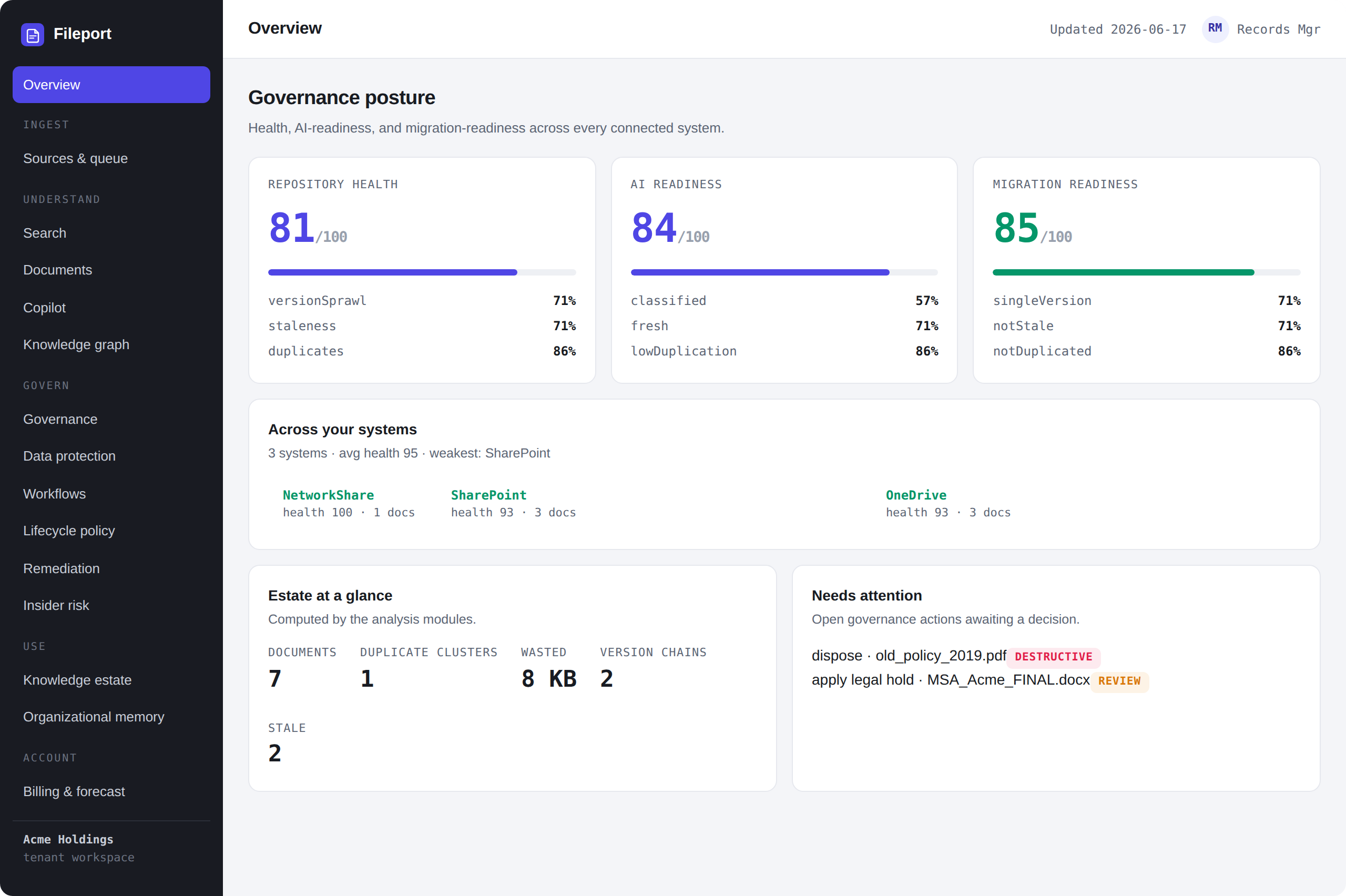
Fileport.ai is an enterprise document intelligence and governance platform that converts unstructured content into organized, searchable, compliant knowledge across your entire organization.

Documents / Day
2.5M+
Unstructured Enterprise Data
80%
Annual Compliance Fines
$14B+
Daily Search Time Lost
2.5 hrs
Section 01 — The Enterprise Challenge
The Problem
The Enterprise Document Crisis
Unstructured data. Governance risk. Operational friction.

Enterprise organizations generate, receive, and manage millions of documents annually. Legal agreements, financial filings, regulatory submissions, compliance records, internal policies, and operational communications accumulate across file systems, email platforms, SharePoint environments, and dozens of SaaS applications — without classification, governance, or systematic accessibility.

The result is predictable and expensive: employees spend an average of 2.5 hours per day searching for information that should be instantly accessible. Legal teams operate without complete document inventories during litigation holds. Compliance teams face regulatory examinations without certainty that their records retention policies have been consistently applied. Risk teams cannot assess the full scope of the organization's document obligations because no authoritative inventory exists.

The average enterprise organization has no accurate inventory of its own documents. It does not know where they are, what they contain, how long they must be retained, or whether they are responsive to outstanding litigation holds. This is not a storage problem. It is a governance failure with direct regulatory and legal exposure.
📦
Document Sprawl
Documents distributed across file systems, email platforms, cloud storage, and SaaS applications with no unified inventory, classification, or governance layer. Organizations lose visibility the moment a document is created.
🔓
Compliance Risk
Regulatory frameworks require retention, disposition, legal hold, and audit trail capabilities that manual processes cannot reliably deliver. Non-compliance carries direct financial and reputational exposure with escalating enforcement frequency.
🔍
Poor Searchability
Unclassified documents cannot be searched with precision. Employees find files by memory of location rather than by content, creating knowledge loss when employees leave and operational inefficiency that compounds daily across the workforce.
📈
Governance Blind Spots
Without systematic classification and metadata extraction, organizations cannot enforce consistent retention schedules, identify documents responsive to legal hold obligations, or demonstrate governance effectiveness to regulators who increasingly require evidence rather than assertions.
60–80%
Retrieval time reduction potential
20–40%
Storage cost reduction achievable
$4.2M
Avg. eDiscovery cost per matter
Section 02 — Platform Capabilities
The Platform
Fileport.ai Platform Capabilities
AI-powered document intelligence from ingestion through governance

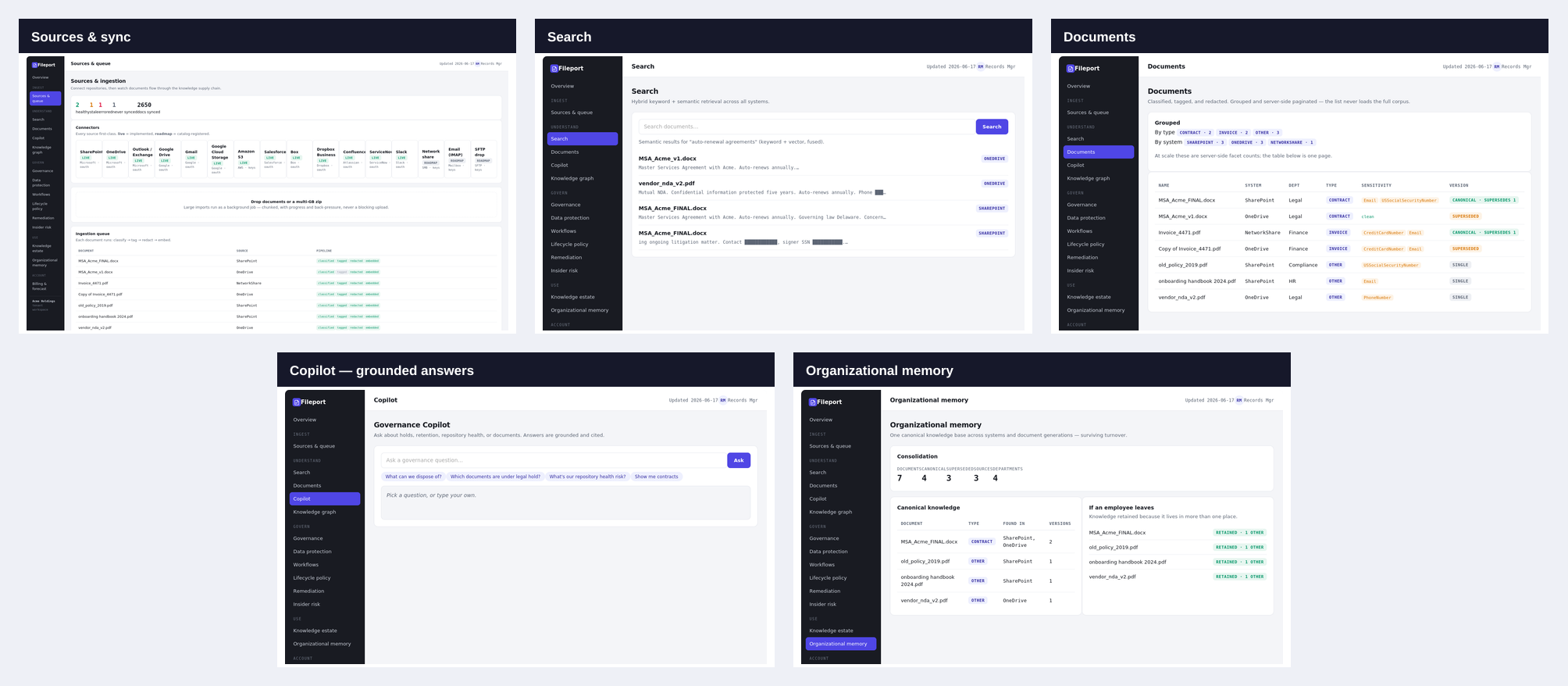
Fileport.ai deploys an integrated document intelligence layer across the organization’s existing content ecosystem. No migration required. The platform connects to existing storage systems, email platforms, and document repositories, and begins classifying, extracting, and governing documents from the point of connection.

🧠
AI Document Classification
Machine learning models trained on enterprise document taxonomies automatically classify documents at ingestion — by document type, business function, regulatory category, and retention schedule — eliminating the manual classification burden that makes governance programs unsustainable at scale.
👁
OCR and Metadata Extraction
Industry-leading optical character recognition converts scanned documents, PDFs, and image-based content into searchable, structured text. Metadata extraction captures author, dates, entity references, and domain-specific attributes that enable downstream classification and governance workflows.
🔎
Semantic Search
Vector-based semantic search enables employees to find relevant documents by meaning and context rather than exact keyword match. Search queries return results ranked by semantic relevance across the full document corpus, dramatically reducing search time and eliminating the dependency on exact terminology.
📄
AI Document Summaries
Generative AI capabilities produce structured document summaries at the point of ingestion, enabling rapid assessment of document relevance without full review. Summary quality is calibrated to document type, with legal and financial document summaries structured to highlight the provisions and figures most relevant to enterprise users.
Compliance Automation
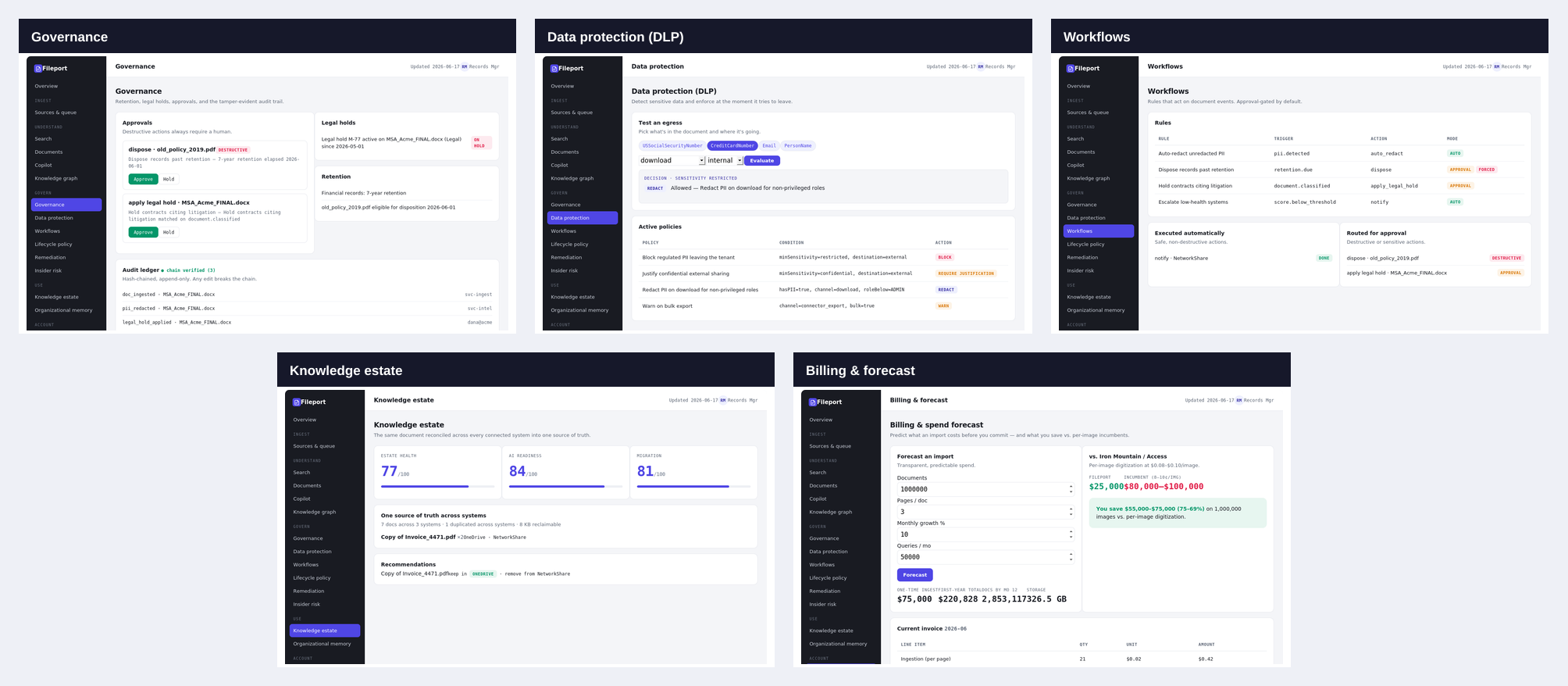
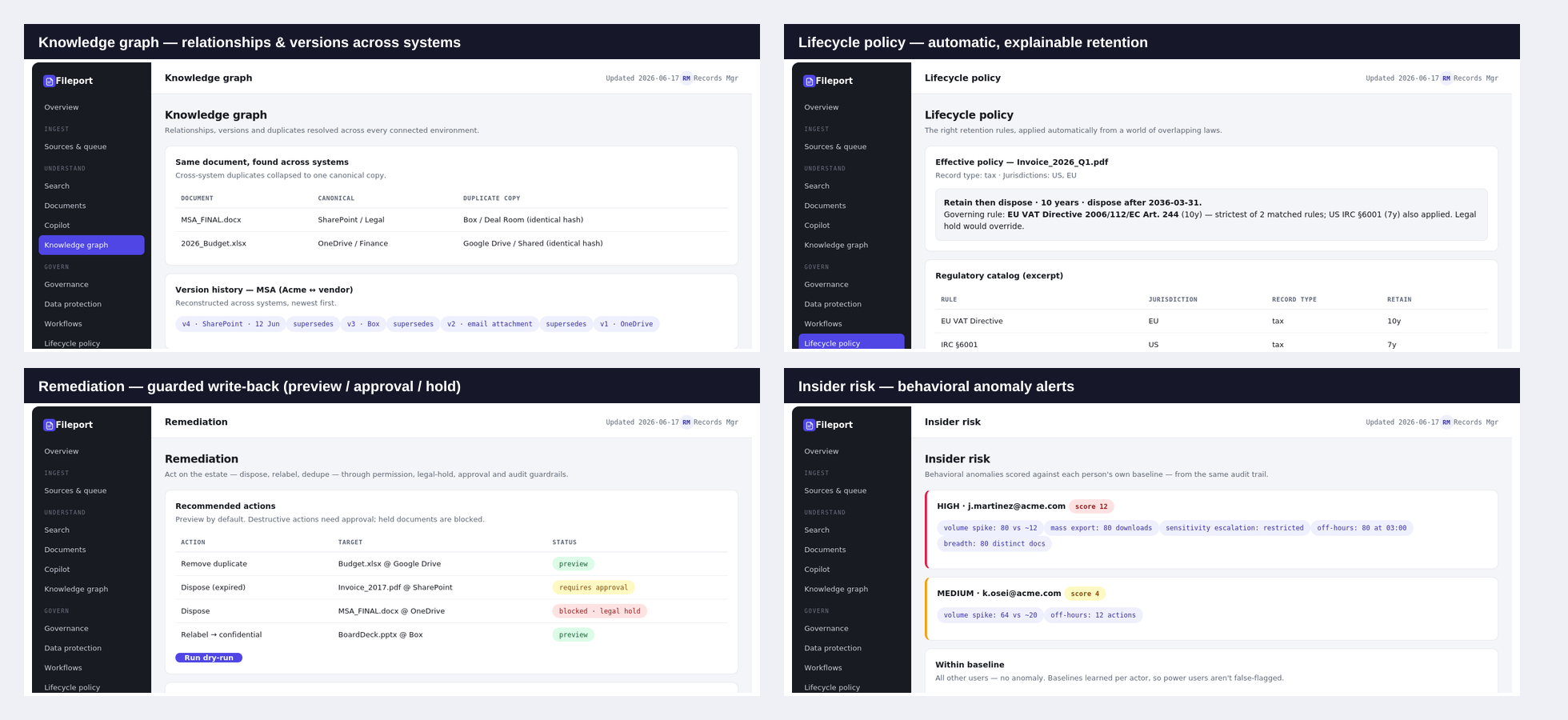
Automated retention schedule enforcement applies classification-based retention rules to documents at ingestion, removing the operational burden of manual retention review from compliance teams and creating an auditable, defensible record of retention decisions that regulators increasingly require organizations to produce.
🔒
Legal Hold Management
Structured legal hold workflow enables legal teams to apply, track, and release litigation holds across the document corpus with full audit trails. Hold coverage reporting provides counsel with documented visibility into hold completeness that satisfies both external litigation discovery obligations and internal legal risk management requirements.
Workflow Automation
Configurable workflow engine automates the document-centric processes that consume compliance, legal, and records management team capacity — document review assignments, approval routing, exception escalation, and disposition review workflows — reducing cycle times and creating consistent, auditable process execution across the governance program.
📈
Retention Management
Schedule-based retention management applies configurable retention rules across document classifications, enforces disposition review at schedule expiration, and provides the documentation of retention decisions that regulatory frameworks require organizations to maintain as evidence of program compliance rather than mere policy existence.
Azure Cloud Architecture
Enterprise-grade Azure cloud infrastructure with autoscaling compute, geo-redundant storage, and the security architecture required for organizations in regulated industries. SOC 2 Type II, ISO 27001, and HIPAA-eligible configurations available with the audit documentation required for enterprise information security review and vendor due diligence processes.
Section 03 — Technical Architecture
Architecture
Platform Architecture
Five-layer document intelligence and governance pipeline
// Fileport.ai — Document Intelligence Architecture v2.1
L1
Enterprise Content Sources
SharePoint • Email platforms • File servers • Cloud storage • SaaS applications • Legacy document management systems • Scanned document archives
SharePointExchangeOneDrive S3 / GCSNetwork SharesLegacy DMS
L2
Fileport Ingestion Engine
Continuous connector-based document ingestion with deduplication, format normalization, OCR processing, and metadata extraction across all connected source systems
ConnectorsOCRFormat Normalization DeduplicationMetadata Extraction
L3
Document Intelligence Layer
AI classification, semantic embedding, entity extraction, document summarization, sensitivity classification, and vector indexing for semantic search across the full document corpus
AI ClassificationSemantic Embeddings Entity ExtractionSummarizationVector Index
L4
Governance and Compliance Automation
Retention schedule enforcement, legal hold management, disposition review workflows, audit trail generation, and regulatory framework alignment across SEC 17a-4, FINRA, HIPAA, SOX, and GDPR
RetentionLegal HoldAudit Trail SEC 17a-4HIPAASOXGDPR
L5
Enterprise Knowledge Platform
Semantic search, document discovery, workflow automation, reporting dashboards, API access, and role-based knowledge delivery across the enterprise user population
Semantic SearchWorkflow Engine REST APIDashboardsRBAC
Section 04 — Enterprise Applications
Use Cases
Enterprise Use Cases
Fileport.ai deployed across legal, compliance, finance, and operations
Legal Operations
Legal Team Document Governance
Legal operations teams deploy Fileport to maintain authoritative contract repositories, automate legal hold identification and management, and reduce eDiscovery preparation costs through continuous classification of potentially responsive documents rather than emergency review at the onset of litigation proceedings.
Regulatory Compliance
Compliance Records Management
Compliance teams manage regulatory obligations, internal policy documentation, examination response preparation, and audit trail maintenance through Fileport’s governance automation. Retention schedules calibrated to specific regulatory frameworks automate the disposition decisions that manual programs cannot sustain at enterprise scale.
Financial Services
Financial Document Intelligence
Investment banks, asset managers, and financial institutions use Fileport to classify and govern the document-intensive workflows inherent to financial operations: offering documents, regulatory filings, client communication archives, trade documentation, and the audit-ready records that financial regulators require organizations to produce on demand.
Knowledge Management
Corporate Knowledge Systems
Enterprise knowledge management programs deploy Fileport to transform accumulated document archives into searchable knowledge resources that retain institutional knowledge as personnel turnover occurs, enable faster employee onboarding, and surface relevant precedent documentation at the point of need rather than requiring employees to know which document exists.
Records Management
Enterprise Records Programs
Records management functions use Fileport to automate the classification, retention, and disposition workflows that manual records programs require dedicated staff to execute inconsistently. Continuous classification at ingestion eliminates the backlog accumulation cycle that makes periodic manual classification programs permanently behind the volume of records being created.
Healthcare
Healthcare Document Compliance
Healthcare organizations use Fileport to manage the intersection of clinical documentation, regulatory compliance, and HIPAA obligations. Patient record governance, clinical trial documentation, and regulatory submission management benefit from the classification accuracy and audit trail capabilities that manual processes cannot reliably provide across high-volume healthcare document environments.
Section 05 — Enterprise Value
Benefits
Enterprise Benefits
Measurable improvements across discovery, compliance, and operational efficiency
🔍
Faster Document Discovery
Semantic search and AI classification reduce document retrieval time by 60–80%. Employees find relevant documents in seconds by meaning and context rather than searching by folder location or exact filename. Knowledge that lived in institutional memory becomes systematically accessible to the full organization.
Reduced Compliance Risk
Automated retention and disposition management eliminates the inconsistent application of retention schedules that creates regulatory exposure. Legal hold management with complete audit trails satisfies the documentation requirements of regulators who increasingly examine governance process quality rather than merely policy existence.
Automated Governance
Classification-driven governance workflows execute retention, review, and disposition decisions automatically across the full document corpus, removing the manual review burden that makes records management programs unsustainable as document volumes grow. Governance consistency improves while compliance team capacity is freed for higher-value activities.
📊
Reduced Storage Costs
Systematic disposition of documents past retention schedule reduces storage volume 20–40%. Organizations pay to store, backup, and manage documents indefinitely when retention-based disposition would eliminate the majority of retained volume — a cost reduction that the governance investment required to achieve it typically pays back within the first year of operation.
🔑
eDiscovery Cost Reduction
Continuous classification of potentially responsive documents dramatically reduces the emergency review cost of litigation discovery. Organizations with Fileport-governed document environments enter litigation holds with current document inventories rather than requiring emergency classification of years of accumulated unclassified content at attorney review rates.
🌞
Knowledge Continuity
Institutional knowledge captured in documents becomes organizationally accessible rather than privately held by the employees who created it. Semantic search surfaces relevant precedent, prior analysis, and historical documentation at the point of need, preserving organizational knowledge through personnel transitions that previously cost organizations the accumulated insight of departing employees.
Section 06 — Enterprise Engagement
Contact
Request Enterprise Demo
Speak with the Fileport Intelligence Team

Speak With the Fileport Intelligence Team

Fileport.ai engages with enterprise legal, compliance, financial, and records management teams facing document governance challenges at scale. Enterprise demos are calibrated to your specific document environment, regulatory obligations, and governance requirements.

intel@fileport.ai

Initial discussions are conducted under mutual confidentiality. Demo environments are configured to your document types and use cases. We engage with legal, compliance, IT, and records management leaders and teams.

Platform
Fileport.ai Enterprise
Demo Type
Configured to your environment
Response Time
1–2 business days
Contact
intel@fileport.ai
Company
A Starship Holdings Company
By submitting, you authorize Fileport.ai (Starship Holdings LLC) to contact you regarding enterprise platform capabilities. Submissions are directed to intel@fileport.ai.